Chef's Office Academy

The Academy

Five modules that take you from reading a P&L for the first time to running a kitchen like the person who owns it.

5
Modules
25
Weeks
47
Lessons & workbooks
Lifetime access
$1,495
One payment, or 5 × $299 a month
Lifetime access to all five modules
Where this starts

You were trained to cook. Nobody trained you to run it.

You know your craft. You can hold a section through a full book and run consistency when the roster falls apart. That took years, and it is not in question.

What the industry almost never teaches is the business the cooking lives inside. So the P&L arrives at month end in a language nobody explained, the food cost drifts for reasons nobody can name, and the chefs who get promoted are not always the ones who cook best.

The Academy closes that gap in full. Not a summary of it, and not a weekend of theory. Twenty-five weeks of structured work that ends with you able to read a business, engineer a menu, run a kitchen as a system, lead a team that holds standards without you, and manage your own career with evidence.

What the gap costs while it stays open

On a venue turning over $100,000 a week, letting prime cost drift by three points is roughly $156,000 a year. Nobody decides to lose it. It leaks while everyone is busy doing their job.

What you work through

Five modules, in order, each built on the one before

Every module is six to five weeks of lessons, workbooks and real exercises. You do not skip ahead, because each one assumes the last.

01
6 weeks

Financial Foundations

Reading the business in financial terms, and knowing where it stands.

  • Prime cost as behaviour, not a percentage
  • Stock movement, usage and the cost of variance
  • The true hourly cost of labour and revenue per labour hour
  • Dish contribution and the four-quadrant menu classification
  • Reading a P&L line by line, and a framework for acting on it
02
5 weeks

Menu Engineering

Designing revenue into the menu before service begins.

  • The menu as a financial and operational system
  • True ingredient cost after yield, and the dishes you are mispricing
  • Expected versus perceived value, anchoring and description design
  • Caloric load, dessert and sides conversion as revenue layers
  • A full engineering pass with a projected financial gap
03
5 weeks

Operational Systems, Labour and Performance

Running the kitchen as a measurable, repeatable operation.

  • Systems versus heroics, and what falls apart on your day off
  • Standardised recipes, prep sheets and portion control
  • Receiving, rotation and waste as daily financial controls
  • Demand-based rostering and revenue per labour hour
  • The Kitchen Scorecard and a weekly operating cadence
04
4 weeks

Leadership and Team Management

Building a team that holds the standard when you are not there.

  • The shift from best cook to actual leader
  • Setting standards the team can own, and holding them fairly
  • Feedback that corrects the work rather than attacking the person
  • The real cost of turnover, and onboarding that keeps people
  • Leading under pressure, and your Leadership Operating Plan
05
5 weeks

Your Career, Your Business

Turning all of it into evidence, and managing your career as an asset.

  • Where you stand across six capability dimensions
  • What makes you genuinely difficult to replace
  • Creating opportunities rather than waiting to be noticed
  • Your career as a balance sheet, not a job history
  • A finished portfolio you can use with owners and operators
How it runs

One week at a time, one module at a time

You start in Module 1. A new week opens every seven days, and completing each week's workbook unlocks the next. When you finish a module, the following one opens.

That pacing is deliberate. The material is built to be applied between shifts, and the chefs who get the most out of it work one week properly before the next arrives. Nothing expires, and once a week is open it stays open permanently.

MODULE 1 Financials MODULE 2 Menu MODULE 3 Systems MODULE 4 Leadership MODULE 5 Your Career Roughly one module every five to six weeks, at your own pace
  • 0122 weekly lessons written for chefs, not accountants
  • 0225 workbooks with real exercises on your own numbers
  • 03The Kitchen Lab, one venue you work inside all five modules
  • 04Five module assessments and capstones
  • 05Lifetime access, including every future update
  • 06An optional wrap-up session at the end of each module
How the work is done

You practise on a real venue before you touch your own

Every module runs inside the Kitchen Lab: a dinner-led coastal café, around 90 seats, $2.4 million a year, running a deliberately stressed prime cost. It is not a tidy textbook example. It is a venue under the same pressure yours is.

The Lab carries across all five modules, and its numbers build as you go. The costing you fix in Module 2 changes the classification you built in Module 1. The systems you design in Module 3 protect the margin you engineered in Module 2. By Module 5 you have run a full operating cycle on one business.

Why it works this way

You diagnose the Lab first, where being wrong costs nothing. Then you run the same analysis on your own kitchen, where it counts.

Before you enrol

Whether the full Academy is the right call

Twenty-five weeks is a real commitment. It is better for both of us if you work out now whether it suits you.

The Academy is for you if
  • You are a sous, head chef, executive chef or owner-operator
  • You want the whole path rather than one piece of it
  • You are aiming at a role you are currently passed over for
  • You are prepared to do the work across six months
  • You want evidence of capability, not a certificate
Start with Module 1 instead if
  • You want to see how the teaching lands before committing further
  • Your immediate problem is financial, not operational or people
  • You would rather spread the decision across the year
  • Six months is more than you can commit to right now
On starting smaller

Module 1 on its own is $299, and it is a completely reasonable way in. If you take it and later want the rest, you pay the difference rather than starting again. See Module 1

Who teaches it

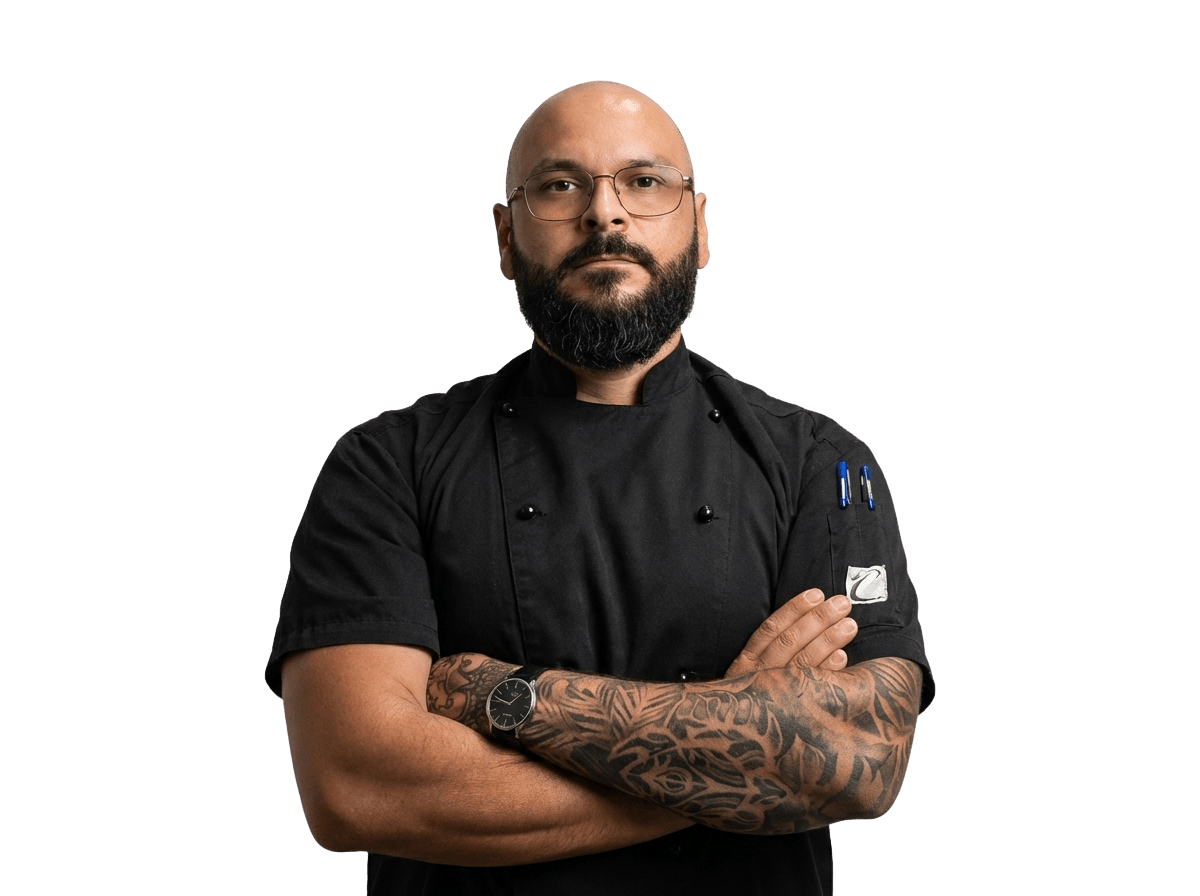
Ricardo Calderini

Around twenty years in kitchens, and a bachelor's degree in business administration and finance. Trained at a leading university in Brazil and worked in corporate roles before choosing the kitchen instead.

Five businesses owned. That combination is the reason this material exists: the finance training to know what the numbers mean, and enough years on the pass to know what they feel like at 7pm on a Saturday.

What it costs

The Academy against buying the modules separately

Module 1 · Financial Foundations$299
Module 2 · Menu Engineering$499
Module 3 · Operational Systems$499
Module 4 · Leadership$499
Module 5 · Your Career$499
Bought separately$2,295
The Academy$1,495
You save $800, and every module works out at $299.
All five modules · 25 weeks
$1,495
One payment. Lifetime access. Start today.
or 5 payments of $299 a month · roughly one module per payment
47 lessons and workbooks · The Kitchen Lab · Five capstones
Optional wrap-up session at the end of every module
Questions chefs ask

Before you decide

Do I get everything at once?

No, and that is deliberate. You start in Module 1 and work through in order, one week at a time. Each module opens as you complete the one before it. Twenty-five weeks of material released at once would be overwhelming and, more importantly, would break the sequence the curriculum is built on.

How long does the whole thing take?

Around six months if you keep pace, longer if life gets in the way. Nothing expires and there is no deadline. Around two to three hours a week is the realistic commitment.

What if I already bought Module 1?

You pay the difference, not the full price again. Get in touch and we will send you the upgrade link.

Is the payment plan more expensive?

No. Five payments of $299 is $1,495, the same as paying once. It exists to make the commitment easier, not to charge you more for it.

I am not a head chef yet. Is this too advanced?

It is arguably more useful earlier. A CDP or sous who can read prime cost and engineer a menu is doing something almost nobody at that level can do, and it is the clearest reason to be considered for the next role.

My venue is not a café. Does the Kitchen Lab still apply?

Yes. The Lab is a specific venue so the numbers are concrete, but every principle is structural. Chefs apply this in pubs, restaurants, hotels, catering and QSR. The figures change. The framework does not.

Is there a live component?

The lessons and workbooks are self-paced. At the end of each module there is a wrap-up session, and it is genuinely optional. The modules are built to be complete without it.

What do I actually have at the end?

The capability, and the evidence of it. Module 5 produces a five-section portfolio built from your own work: your capability assessment, what makes you hard to replace, your outcomes with numbers attached, and a plan for where you are going. It is designed to be handed to an owner or operator.

Six months from now, you will either read your kitchen or you will not.

The numbers are moving either way. The only question is whether you can see them, name them in dollars, and do something about them while there is still time.

Enrol in the Academy · $1,495
One payment or 5 × $299 a month · Lifetime access · Start today